Your model knows what steel you need.
Your warehouse knows what you have.
OnStock does the math.
OnStock reads your IFC model, matches it against your real inventory, and tells you what to cut each part from, which sheet to nest each plate on — and exactly what to order for everything stock can't cover.
The model and the warehouse
live in separate worlds
The material demand sits in a BIM model. The inventory sits in an ERP or a spreadsheet. Between them is a person with a calculator, a takeoff that has to be redone every revision, and a rack full of leftovers nobody can account for. So you order for safety, and the surplus becomes next year's clutter.
Four steps from model to purchase list
01
Load the model
Drop your IFC and OnStock connects with the geometry: every element, its section, grade, and the grades they need for it.
02
Load your stock
CSV, Excel, or our API. OnStock imports what you actually have on hand — part numbers, lengths, grades, locations.
03
Nest against what you have
Removes from the list what existing stock can serve, by length, by grade, by how close the part is. It does it flow-by flow.
04
Buy the difference
Showcases from the list what left and adds what other stock could not, prorating longer lengths your supplier offers.
Cut from what's already in the rack
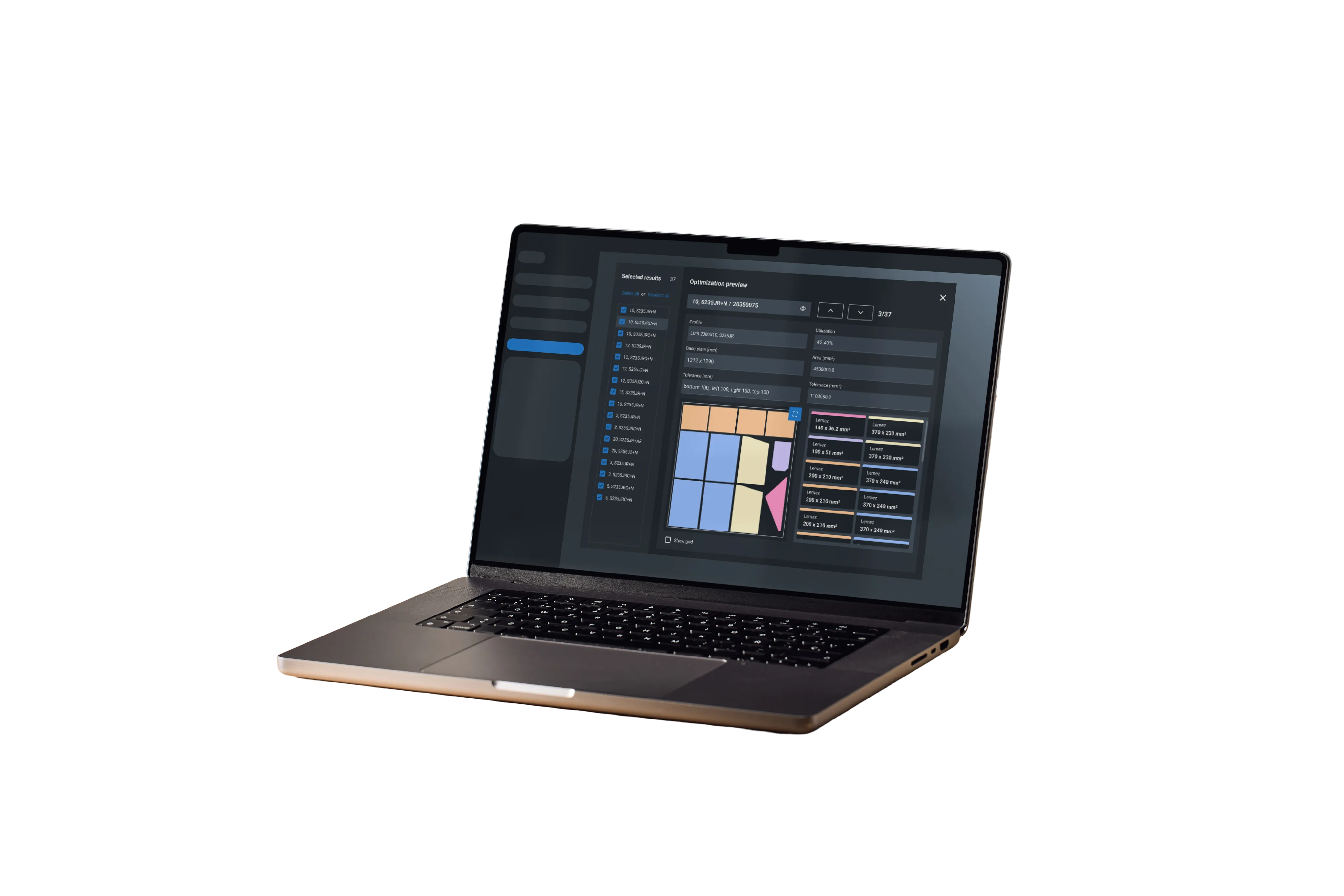
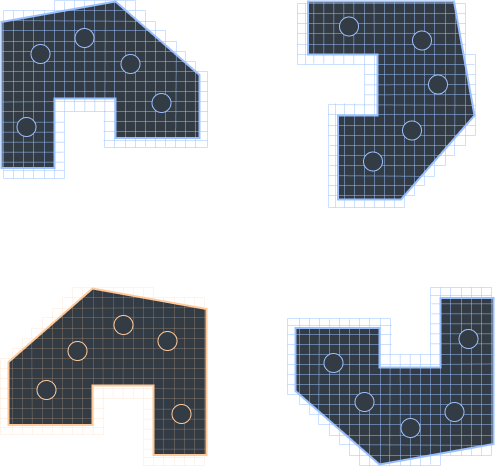
True shape nesting for plates. Linear nesting for bars — both running against your real inventory rather than theoretical stock. Parts are nested by their actual cutline, so they interlock instead of queueing up in rows.
Which stock gets used first is your call: sort by length, by area, or by how long it's been sitting in the yard. Run it first-in-first-out, or clear the smallest remnants first, or whatever your yard actually treats as priority. Getting rid of the half-used sheet that's been in the way for eight months is usually worth more than a percentage point of density — and OnStock is one of the few tools that lets you say so.
You're not out of stock.
You're out of that exact size.
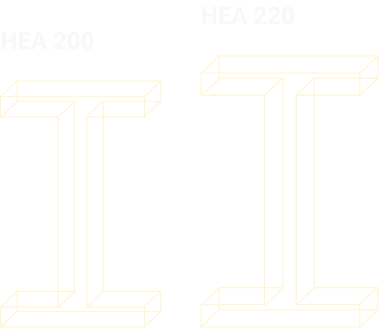
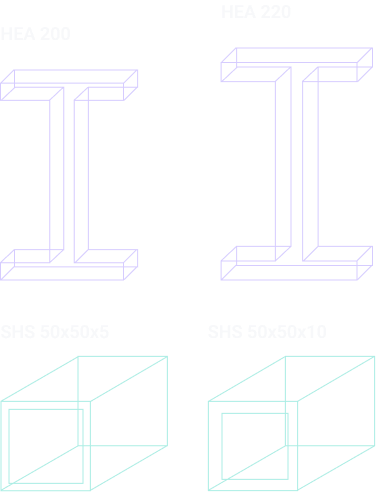
Every experienced buyer carries a substitution table in their head — a size up in the same family will do, a slightly thicker plate is fine. Software doesn't know this, so it reports a shortfall and orders new steel while the substitute sits in the rack.
OnStock works from the European section catalogue and lets you write those judgement calls as rules. Allow HEA to step up one size in height, and a HEA 220 in stock becomes a candidate for a HEA 200 demand. Hollow sections get their own steps in width and thickness. Plates can step up in thickness. Set the rules once; every job applies them.
Buy the difference,
not the bill of materials
Most tools give you a tonnage. A tonnage isn't an order. OnStock takes the demand your inventory couldn't absorb and re-optimizes it against purchasable lengths and sheet formats, so what you order cuts cleanly instead of generating a fresh pile of unusable offcuts. You get a purchase list by profile, grade and length — and you see the waste your order will create before you place it.
Optimize what to buy
Use standard
lenghts & sheets
Order-ready
purchase list
Minimize waste

A BOM gives you a bounding box.
The model gives you the part.
Most optimizers start from a spreadsheet. For plates that falls apart immediately: an outline in a BOM line is a rectangle, not an outline, so the numbers already contain waste before nesting begins and nobody can tell how much.
OnStock works from the BIM model — real contours, real lengths, real thicknesses, real grades, read from the geometry rather than trusted to a property field somebody forgot to fill in. When the model is revised, you re-run it. You don't redo the takeoff.
IFC files that fight back
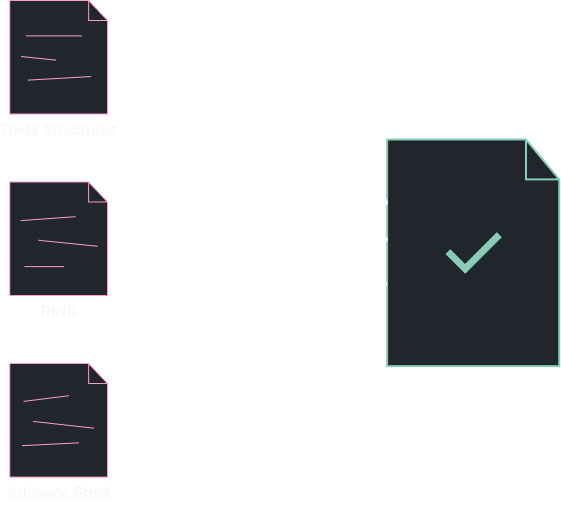
Every authoring tool exports differently. Different property sets, missing material names, inconsistent profile designations, conventions that change from one engineering office to the next. OnStock normalizes Tekla, Revit and Advance Steel exports into one clean data model, and recognizes standard European profiles and plate designations, and derives what it needs from the solid when the attributes aren't there.
You're not debugging someone else's export before you can start.
Don't take our word for it. Load a model.
This is the reading half of OnStock, running right here in the page. Open the sample structure, or drop in one of your own. Click any member and see what we pull it from — length, profile, grade, plate thickness, contour — read from the geometry rather than trusted to a property field.
The nesting, the substitution rules and the purchase list run on the full product. This is what feeds them.
We're upstream of your cutting machine, not a replacement for it
OnStock answers what's in stock and what to buy — it doesn't know your machine's specifics (lead-ins, compensation, common-line cutting), that's CAM's job. So its layouts are planning-grade, not machine-grade: precise enough to make your quote, order, and remnant list reliable, but the final toolpath stays with your machine software. If you already run a nesting package, you don't need to replace it — OnStock fills the gap in front of it.
Built on open foundations
Fabrication models are not small. Thousands of members, every plate and stiffener modelled, exported at full detail — and most viewers either take minutes to load that or quietly give up. OnStock opens files at that scale in a browser tab and stays responsive enough to actually work in: orbit the structure, click a member, jump from a line in the cut list to the part it came from.
The viewer further up this page is that, running live — built on the open-source components from That Open Company. Steel fabrication is a hard test for any IFC stack: geometry-dense, property-inconsistent, and large. Running our optimization on top of that foundation means the model stays the single source of truth from import through to the purchase list.
The nesting engine follows published research on irregular cutting stock, adapted from the single stock-size case the literature assumes to the pile of mismatched remnants a real yard holds.
We build on open standards and open technology because we think that's how BIM tooling should work. IFC isn't an export format. It's a working format — and everything here rests on the assumption that it can carry real production data, not just a visual handover.
Start with a spreadsheet.
Talk to us about the ERP.
Excel and CSV import works out of the box — no integration project, nothing to schedule. Enough to run real jobs from day one.
For ERP, we've built a validated QAD integration through the interface your system already exposes — no direct database access needed. We won't claim a generic connector, though: a decade-old ERP has been shaped around your business, and "plug-and-play" usually means you do the mapping work. Tell us what you run and we'll scope it properly.
Already on QAD? There's no integration project to sit through.
This is the one ERP connection we've actually built and run end to end, not scoped on a slide. We don't talk to QAD's core directly — we go through an interface already exposed by a QAD implementation partner, the same layer their own customizations and add-ons use. OnStock reads item master and inventory balances through that interface, so the nesting runs against what the warehouse shows right now instead of last week's export — no CSV bridge to babysit, no lag between the shop floor and the nesting run.
Written inside a steel fabrication business, not next to one
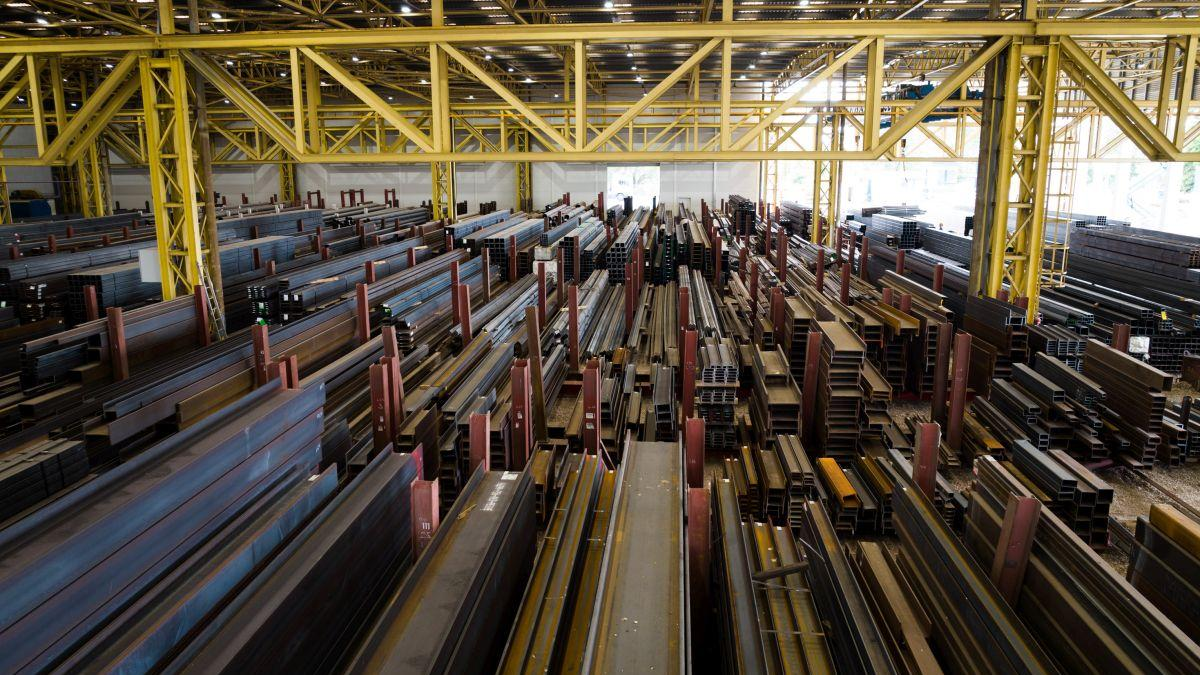
OnStock is developed within KÉSZ Group, whose 25,000 m² Kecskemét plant ships over 20,000 tonnes a year across Europe. It grew out of the group's structural software team — Consteel has been used by design offices for two decades — so both ends of the problem were already in the same building: the model, and the yard where it meets real steel. Nobody had to explain to us what happens to a beautiful model at the factory gate.
We're looking for a few fabricators to build this with
OnStock is going out at our own plant now, and we want a handful of shops outside the group sharing what connect next — which integrations get built first, what constraints actually matter, what output has to look like on a shop floor that isn't ours.
Early partners get direct access to the team, priority on the connections they need, and pricing that reflects the stage we're at. Send us an IFC and a stock list, and we'll show you exactly where it stands.